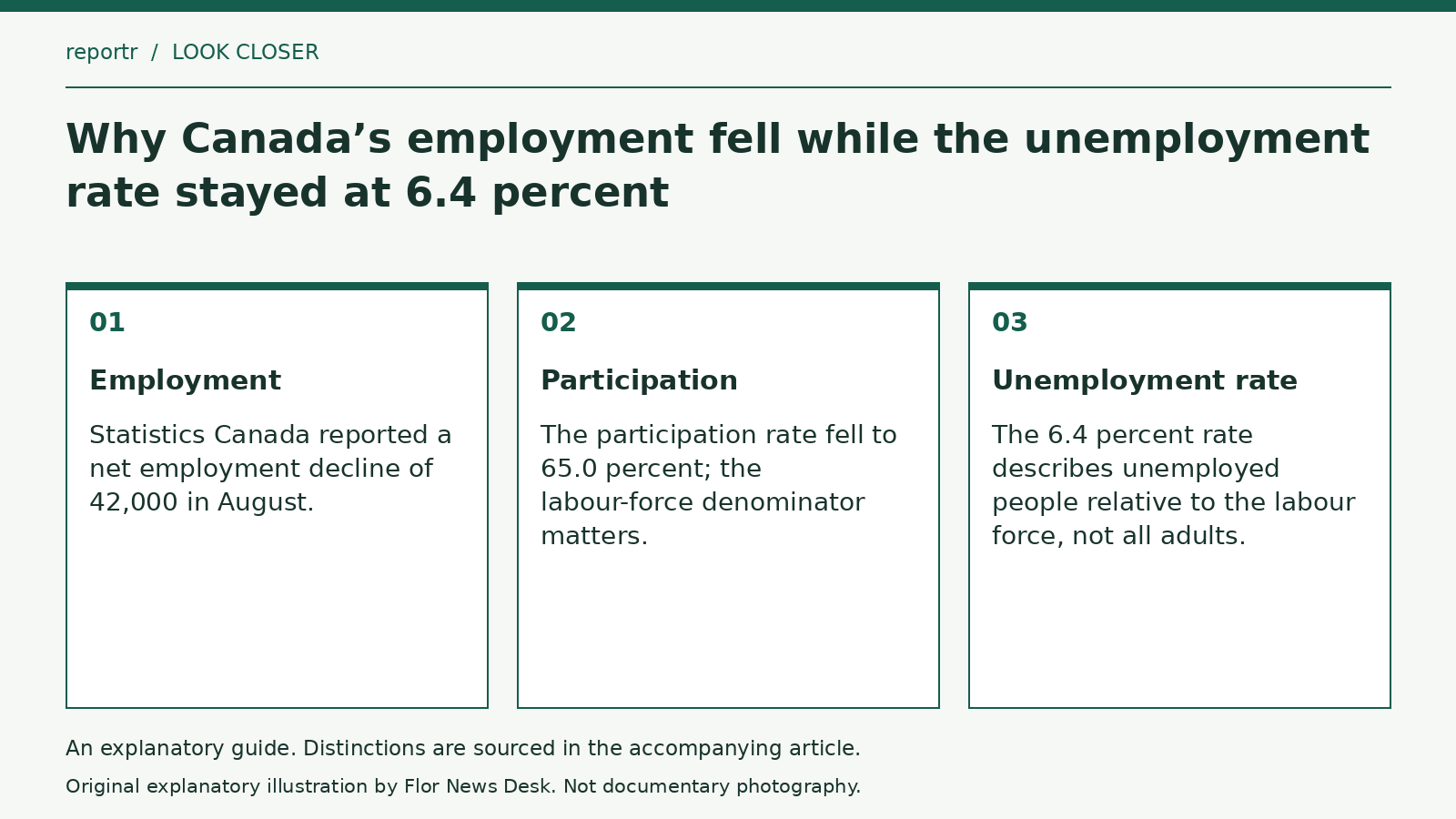
Canadian employment declined by 42,000 in August 2026, while the unemployment rate remained at 6.4 percent. Statistics Canada’s September 4 Labour Force Survey release also reported a participation rate of 65.0 percent, down 0.1 percentage points, and an employment rate of 60.8 percent. Together, these measures describe more than the number of people with jobs.
The unemployment rate is not the percentage of all adults without employment. The survey’s conceptual guide separates people into employed, unemployed and outside the labour force. The unemployed category depends on availability and job-search circumstances, with specified exceptions such as temporary layoffs.
The denominator can move
An invented example makes the relationship visible. A labour force of 1,000 containing 60 unemployed people has a 6 percent unemployment rate. A labour force of 900 containing 54 unemployed people also has a 6 percent rate. In this simplified example, employment is lower even though the ratio is unchanged. These are illustrative counts, not a reconstruction of Canada’s August estimates.
This arithmetic explains why employment, participation and unemployment should be read together. It does not identify why any particular person left work or stopped participating. Retirement, education or other personal circumstances would need to be established from evidence rather than assumed from the national totals.
People counted are not every job movement
A net change between two survey observations is also different from the total number of hiring and separation events. In an illustrative workplace, five people might leave while four arrive. The net headcount falls by one, but nine movements occurred. A national net employment change cannot simply be relabelled as the total number of layoffs.
The August survey refers to the week of August 9 to 15. The release notes that monthly estimates are subject to sampling variability and should be considered alongside longer trends. Its date of publication is not a claim that the survey directly observed every day in September.
The central reading lesson is therefore not that the indicators disagree. They answer different questions: how many people are employed, how many participate in the labour force, and what share of that labour force is unemployed. An account that reports only the unchanged rate leaves out the documented employment decline; an account that converts the decline into a layoff total adds something the figure does not establish.