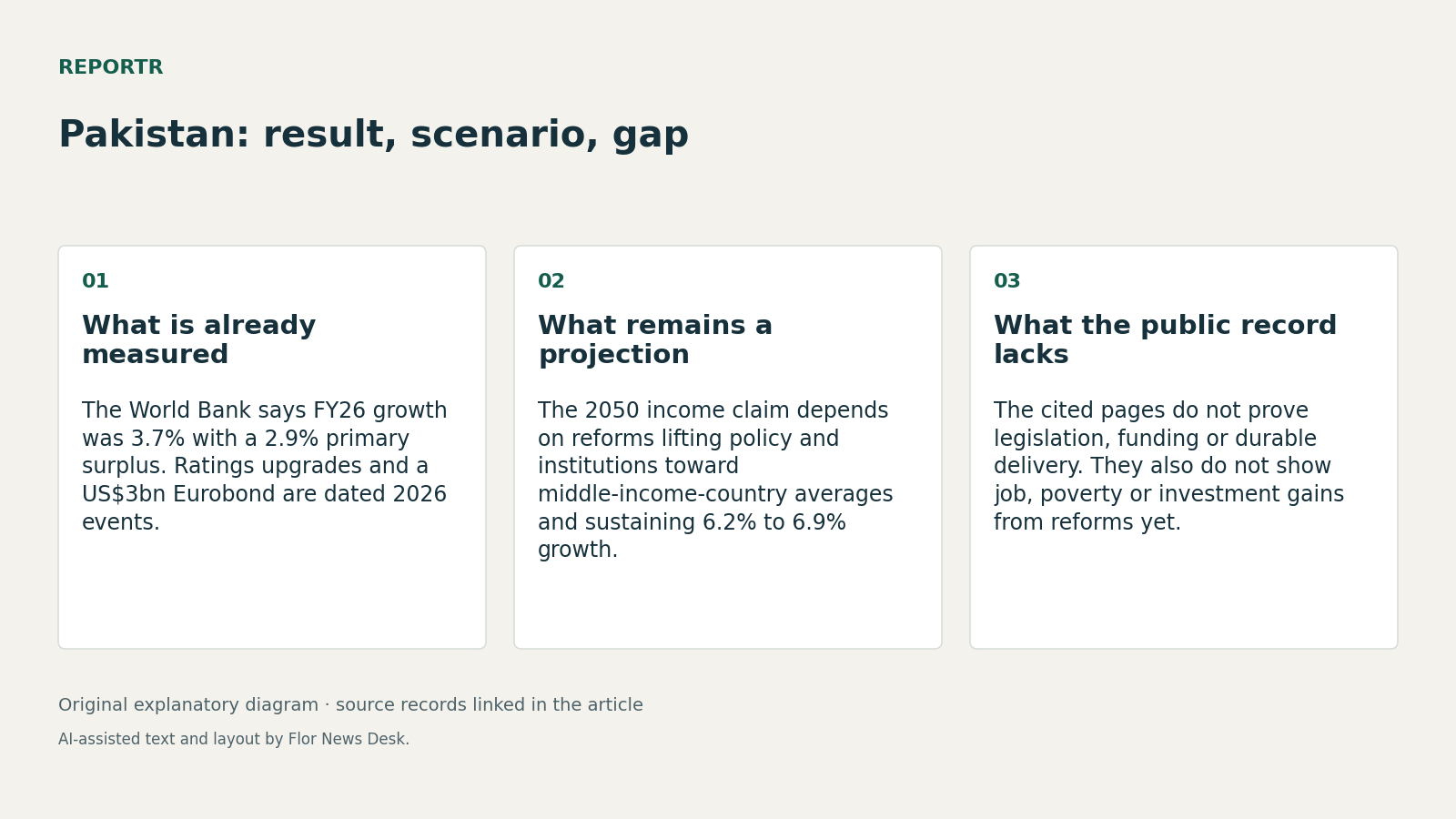
The World Bank’s headline claim on Pakistan is clear, but narrower than it first appears. In a press release published on 22 October 2026, the institution said faster implementation of structural reforms could see incomes triple by 2050, citing a Pakistan Development Update that it says finds growth could be sustained at 6.2% to 6.9% a year if policies and institutions move toward average middle-income-country standards. That is a conditional scenario published by the World Bank, not a measured outcome. World Bank press release
The same release ties that long-run argument to a stronger recent macro picture. The World Bank says Pakistan’s real GDP growth rose to 3.7% in FY26 from 3.2% in FY25, that primary fiscal surpluses reached 2.9% of GDP in FY26, and that strong remittances helped rebuild foreign-exchange reserves. It also says upgrades by S&P and Moody’s were followed by a US$3 billion Eurobond issuance. World Bank press release
A separate World Bank Pakistan country page broadly matches those near-term data points and adds more dated context: 7.1% headline inflation, a consolidated fiscal deficit of 2.6% of GDP, a current account deficit of 0.1% of GDP, an S&P upgrade to B in July 2026, a Moody’s upgrade to B3 in August 2026, and the September 2026 Eurobond sale. The same page says Pakistan’s population was about 251.3 million in 2024, with a Human Capital Index of 0.41 and stunting affecting about 40% of children under five. Those figures help show why a long-run income claim matters, but they do not validate the 2050 path. World Bank Pakistan country page
What would need to happen for the 2050 claim to be more than a modelled possibility is also partly spelled out. The press release says measures already under way include power tariff adjustments that reduced energy subsidies from 1.1% of GDP in FY25 to 0.8% in FY26, trade liberalization under the National Tariff Policy, and the recent privatization of Pakistan International Airlines. On the World Bank’s own terms, those are examples of reform activity, not proof that the whole package has been legislated, financed, sequenced and sustained long enough to produce the growth rates in its scenario. World Bank press release
That distinction matters because the public record here is uneven. The press release is a summary, not the full modelling record. The country page is useful as a consolidated snapshot, but the source brief notes an internal dating problem: its economy section carries a “Last Updated: Oct 09, 2025” label even though it contains FY26 data and 2026 events. That makes the page unreliable as a publication date for each claim on it, even if the figures themselves align with the release. World Bank Pakistan country page
The strongest evidence-led reading, then, is limited but still significant. The World Bank has published a reform-dependent argument that Pakistan could achieve a much higher growth path by 2050, and it has paired that argument with recent signs of macro stabilization in FY26. What the available public pages do not establish is whether the reforms will endure, how they will be funded across years, or whether investment, jobs and poverty outcomes have already shifted in line with the projection. Until those records are visible in dated laws, budgets and later outcome data, the income-tripling claim remains a scenario to test, not a result to report as achieved. World Bank press release World Bank Pakistan country page