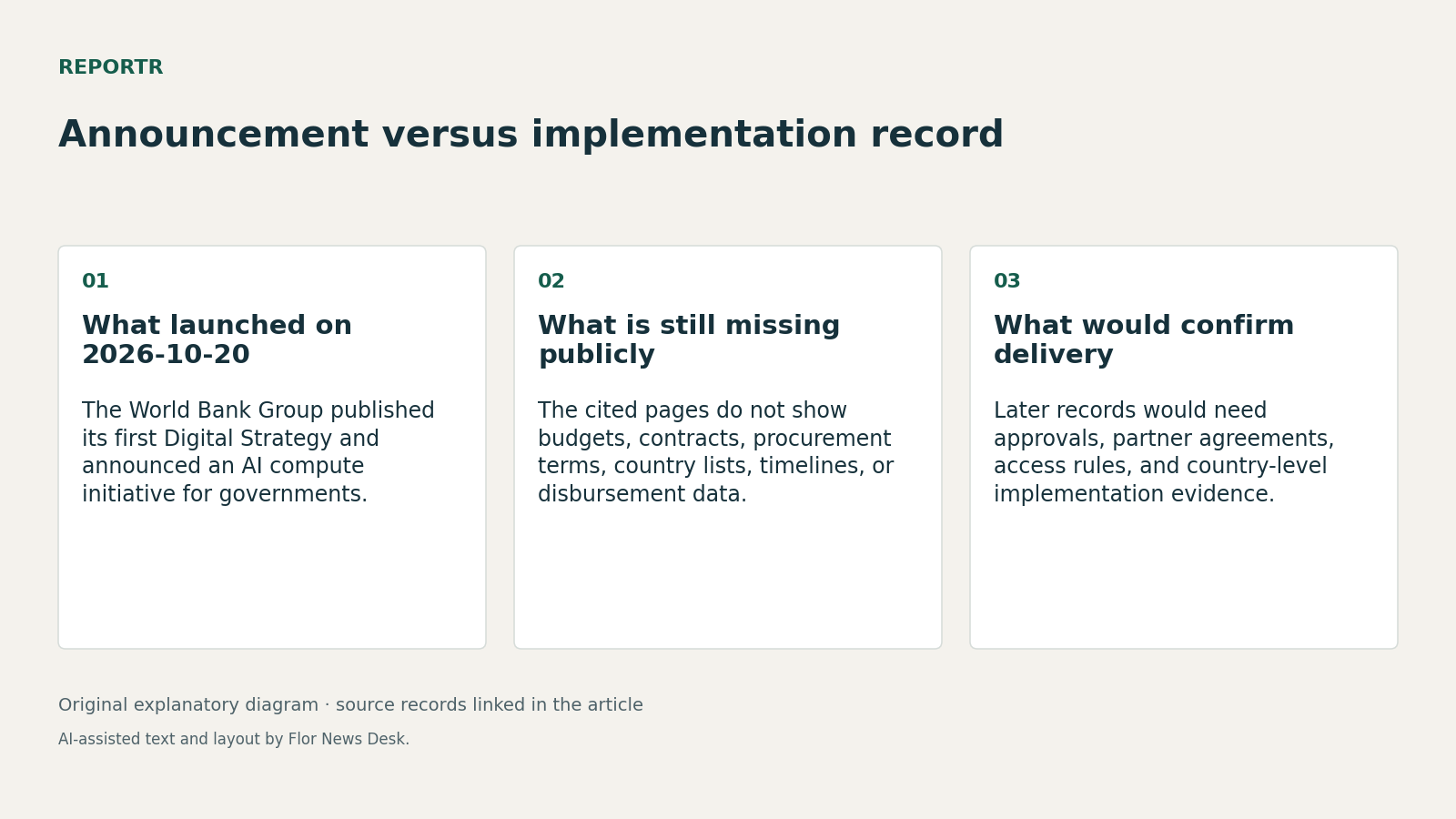
The clearest finding in the public record is narrow but important: on 2026-10-20, the World Bank Group published its first Digital Strategy and, in the same announcement, launched an AI Infrastructure and Readiness Initiative aimed at giving governments in emerging markets access to shared, pay-as-you-go GPU computing (World Bank press release, 2026-10-20). What those pages do not yet show is just as important. In the retrieved record, there is no public budget, no signed partner agreement, no procurement documentation, no country selection list, no operating timetable, and no disbursement record.
The strategy itself is described in broad development terms rather than as a project approval. The 2026-10-20 press release says its four priorities are connectivity, affordability of devices and data, digital services and skills, and foundations for artificial intelligence. The same release frames the problem with large access gaps, saying more than 2 billion people were offline in 2025 and internet use stood at 23% in low-income countries versus 94% in high-income countries. It also links digital policy to labor-market pressure, citing 1.2 billion young people expected to reach working age in developing countries over 10 to 15 years, against roughly 420 million projected jobs (press release).
The new AI initiative is the part most likely to generate premature assumptions. The World Bank says it will initially focus on Africa and Latin America and names Cassava Technologies and NVIDIA as knowledge partners (press release). But naming partners does not, by itself, establish financing, procurement, or delivery. Based on the retrieved pages, readers cannot yet tell whether the World Bank has committed its own funding, arranged guarantees, approved country operations, or simply set out a programmatic model it intends to develop.
The announcement does fit a line of argument the institution had already been building. An April 2, 2026 World Bank brief presents “small AI” as lower-cost, practical systems that can run on everyday devices in settings with limited infrastructure and skills, while the institution’s Data and AI topic page says its approach includes regulation and governance, computing capacity, data ecosystems, sustainable data centers, and scalable cloud solutions (Small AI, Big Impact; Data and AI topic page). Those pages are background, not approval records, but they show that the October launch did not appear from nowhere.
A second continuity point comes from the landing page for the Digital Progress and Trends Report 2025: Strengthening AI Foundations. That page says low- and middle-income countries face major obstacles to adapting or deploying AI at scale and highlights four foundations for AI ecosystems: connectivity, compute, context, and competency (report page). The analysis supported by these records is that the October 2026 strategy appears to translate that framework into institutional priorities, while the AI Infrastructure and Readiness Initiative moves “compute” from a diagnostic category into a proposed service offer. What the available record cannot establish is whether that shift has yet produced country-level operations.
Timing also matters. The launch coincided with the World Bank Group’s Global AI & Digital Summit in Seoul, scheduled for 2026-10-19 to 2026-10-22 and hosted with the Republic of Korea’s Ministry of Finance and Economy and Ministry of Science and ICT (summit page). But that event page is not a reliable status update on implementation. The retrieved page still contains future-oriented wording relative to 2026-10-21, which makes it evidence of planned programming, not of completed milestones or delivered projects.
So the October 20 record is best read as a policy launch with a clearly stated direction and a still-thin implementation trail. The next decisive documents would be financing approvals, procurement notices, signed partner terms, country selection criteria, operating rules for access to GPU capacity, and any country-level safeguards on data governance, privacy, and cybersecurity. Until such records appear, the announcement establishes intent and institutional framing, not verified delivery or outcomes.