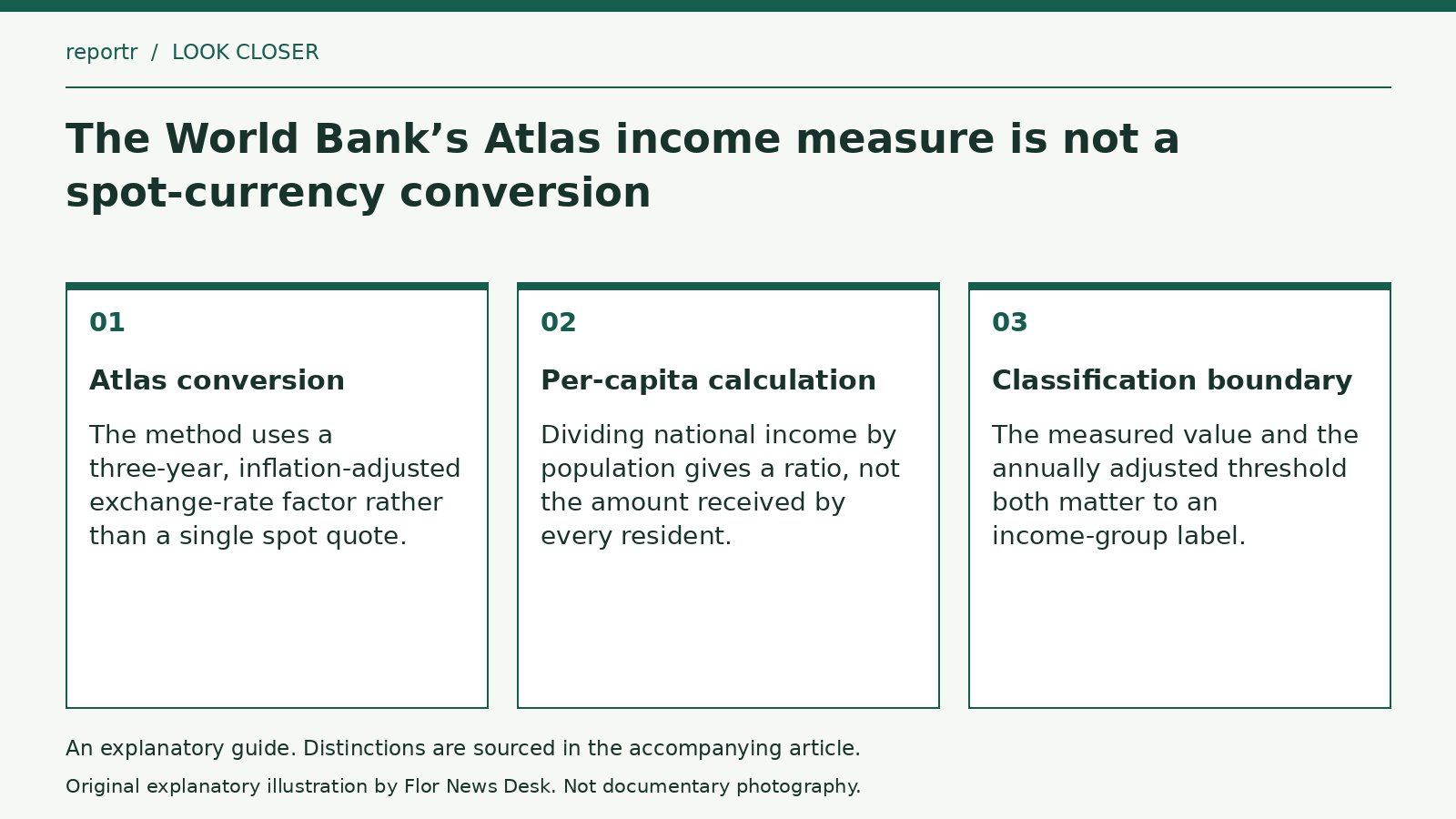
The World Bank’s Atlas method converts gross national income into US dollars using a factor that averages exchange rates over three years and adjusts for differences in inflation. Its method explanation describes the purpose as reducing the effect of exchange-rate fluctuations when comparing national incomes. A spot exchange-rate quote is therefore not the same conversion factor.
That distinction matters when interpreting a change in a country’s reported income per person. Several components are involved: the income estimate, population and the conversion method. A headline currency movement alone cannot establish the resulting Atlas-method figure.
An average across people is another operation
Consider a fictional economy with national income of 50 million units and a population of 1,000. Dividing yields 50,000 units per person. This calculation does not establish that every resident earned that amount. Different distributions of income could produce the same ratio.
Converting those invented units into another currency adds a separate calculation. Changing the conversion factor changes the displayed currency value even if the original income figure is unchanged. This example illustrates the relationship between operations; it does not reproduce the Bank’s full method or assign an income group to an actual country.
The Bank’s threshold-update explanation describes annual inflation adjustments to the boundaries used for income groups. A classification therefore involves both a measured country value and the threshold against which it is compared. A change in a label cannot be fully interpreted without checking both.
Classification is not a complete development profile
An income-group label does not, by itself, describe inequality, local prices, public services or the circumstances of a particular resident. Those are distinct questions requiring other information. It also is not a loan-approval record or a statement that every financing condition for a country has been satisfied.
A hypothetical country could cross an adjusted threshold by a small amount while retaining many of the same structural conditions. The categorical label would change at a boundary, whereas the underlying numerical measure changes continuously. Treating the label as a complete transformation would overstate what the classification establishes.
This explanation concerns the published methodology, not a new September reclassification or a current list of country memberships. No current fiscal-year thresholds are reproduced here. The meaningful comparison identifies the income measure, conversion factor, population, threshold and reference period. Omitting those parts can turn a defined statistical classification into a claim about prosperity or individual earnings that it cannot support alone.