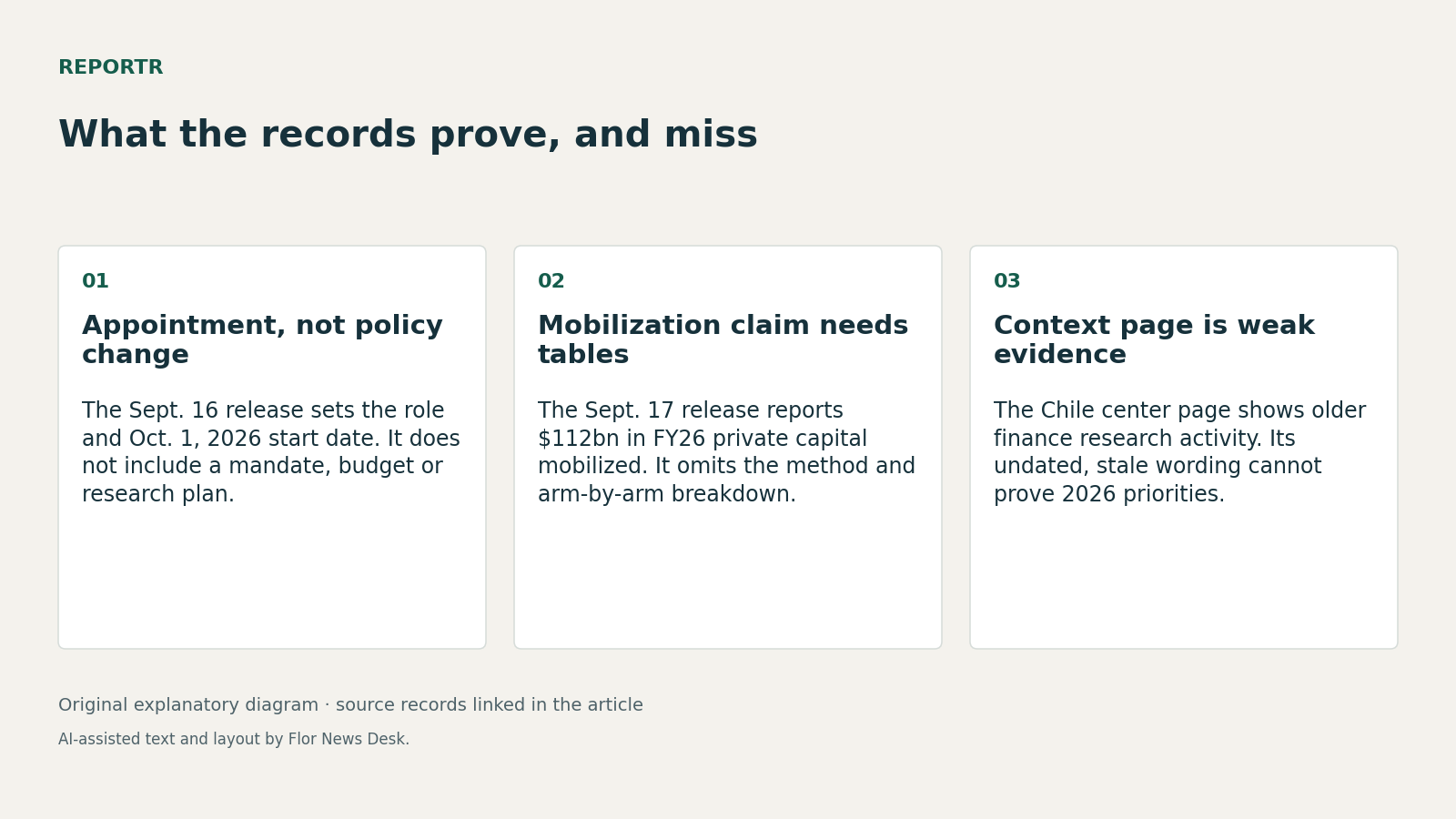
The clearest reading of the record is narrower than the headlines. A World Bank Group release dated September 16, 2026 says Michael Kremer was appointed Chief Economist and Senior Vice President for Development Economics, with the change effective on October 1, 2026. A second release dated September 17, 2026 says the World Bank Group mobilized $112 billion in private capital in FY26. Those documents establish an imminent leadership change and an institutional financing claim. They do not, on their own, establish a new policy line, a changed research programme, or verified economic effects. (appointment release, mobilization release)
The appointment notice is specific about title and timing, but sparse about substance. It says President Ajay Banga announced Kremer’s appointment, identifies his current University of Chicago roles, and says the post leads the institution’s research, data, and analytical agenda. It also notes his 2019 Nobel Prize in Economics. What the release does not provide is the part that would show an operational shift: no formal mandate, no term length, no budget, no reporting structure beyond the title, and no adopted research plan. On the evidence available here, the personnel change is documented; the content of any agenda change is not. (appointment release)
The financing release is also specific in some places and silent in others. It says the Group mobilized $112 billion in private capital in FY26, up from $35 billion in FY22, and that its own financing plus mobilization in developing economies totaled well over $200 billion in FY26. It also says more than $25 billion in guarantees were issued in FY26, and gives changes by income group and for Africa, including $37 billion for lower-middle-income countries, $50 billion for upper-middle-income countries, about $3 billion for low-income countries, and about $22 billion across Africa. But the same release does not supply the methodology for private capital mobilized, the fiscal-year dates, or an audited breakdown across IBRD, IDA, IFC, MIGA, guarantees and other instruments. (mobilization release)
That timing matters. As analysis, the $112 billion figure cannot be evidence of Kremer’s effect on World Bank Group operations, because the release reports an FY26 result on September 17, 2026, while his appointment only takes effect on October 1, 2026. The two releases can still matter together in another way: the first identifies who will oversee the research and analytical side of the institution, and the second shows the kind of headline operational metric the Group is publicly elevating. What they do not show is whether the incoming chief economist will change how that metric is defined, scrutinized or prioritized. (appointment release, mobilization release)
The only additional context in the source record is weaker than it first appears. An undated World Bank Research and Development Center in Chile page says the centre was established in 2017 by the Government of Chile and the World Bank Development Economics Vice Presidency, has been devoted to financial sector work since October 19, 2019, and lists a March 2025 joint IFC-World Bank report on capital markets in low- and middle-income countries. That is enough to show Development Economics has had finance-related research activity before Kremer’s arrival. It is not enough to prove current 2026 priorities: the page has no publication date and, as of September 27, 2026, still described already-past September 23 events as upcoming. (Chile research page)
So the real reporting gap is documentary, not rhetorical. To test the $112 billion claim, readers would need the institution-by-institution and instrument-by-instrument tables, the definition of private capital mobilized used in FY26, the fiscal-year boundaries, and audited or otherwise formal supporting statements. To test whether Kremer’s appointment changes Bank research priorities, readers would need a published mandate, budget, staffing or programme decisions after October 1, 2026. Until those records appear, the strongest evidenced conclusion is modest: the World Bank Group has announced a new chief economist and published a large mobilization number, but the records supplied here do not yet connect those developments to a verified strategic shift or measured outcome. (appointment release, mobilization release, Chile research page)