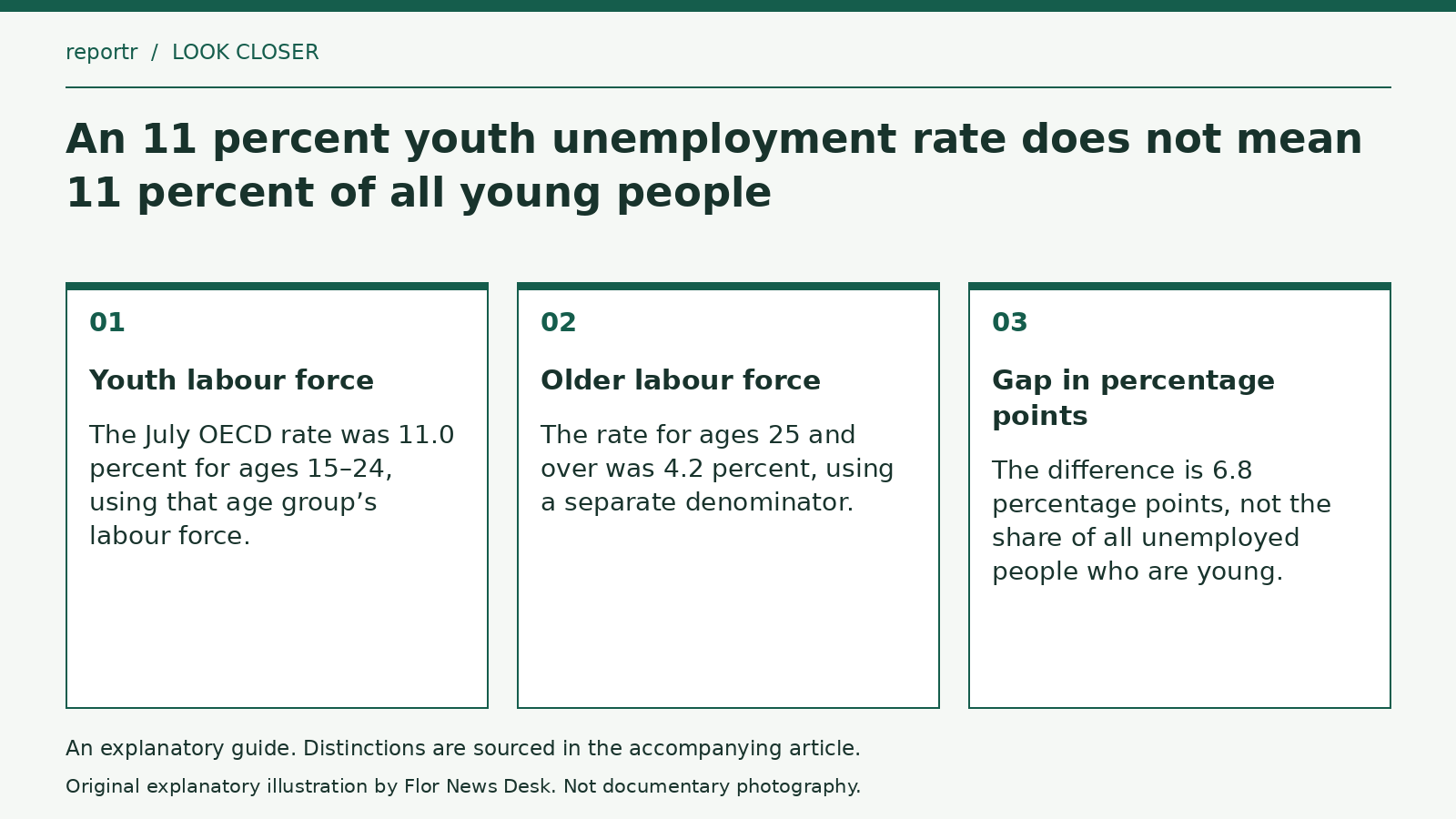
The OECD’s unemployment rate for people aged 15 to 24 was 11.0 percent in July 2026, compared with 4.2 percent for those aged 25 and over. Its September 10 release reported a youth-rate decline of 0.2 percentage points from the previous month. The age comparison is meaningful only when the denominator is understood.
The OECD’s indicator definition expresses unemployment as a percentage of the labour force within the relevant age group. It does not use the entire population of that age group. People outside the labour force are not automatically counted as unemployed simply because they do not have a job.
A rate and a population share
Suppose an invented population contains 1,000 young people, of whom 500 are in the labour force and 55 are unemployed. The unemployment rate is 11 percent of the labour force. The unemployed group is 5.5 percent of the full young population. Both calculations use the same invented people but answer different questions.
These are illustrative counts, not an estimate of participation in OECD countries. They show why replacing the phrase youth labour force with all young people would change the reported meaning.
Percentage points are not a percentage change
Subtracting the two published July rates yields a gap of 6.8 percentage points. That describes the difference between rates, not the share of unemployed people who are young. Determining that share would require the sizes of the relevant groups as well as their rates.
A separate calculation would compare one rate proportionally with the other. Such a ratio is different from the percentage-point gap. A chart or headline should specify which operation it reports rather than using percent and percentage points interchangeably.
The OECD definition relies on people being without work, available and actively seeking employment, within the survey framework. It does not describe every form of dissatisfaction with work, insufficient hours or a desire to enter employment later. Those questions may be important, but they are not answered by relabelling the unemployment rate.
The September release reports July observations for the OECD comparison. It does not establish that every member country had the same youth rate or experienced the same monthly change. The useful interpretation retains the age group, labour-force denominator, period and unit of comparison. Without those labels, a carefully defined rate can easily become an unsupported statement about a whole generation.