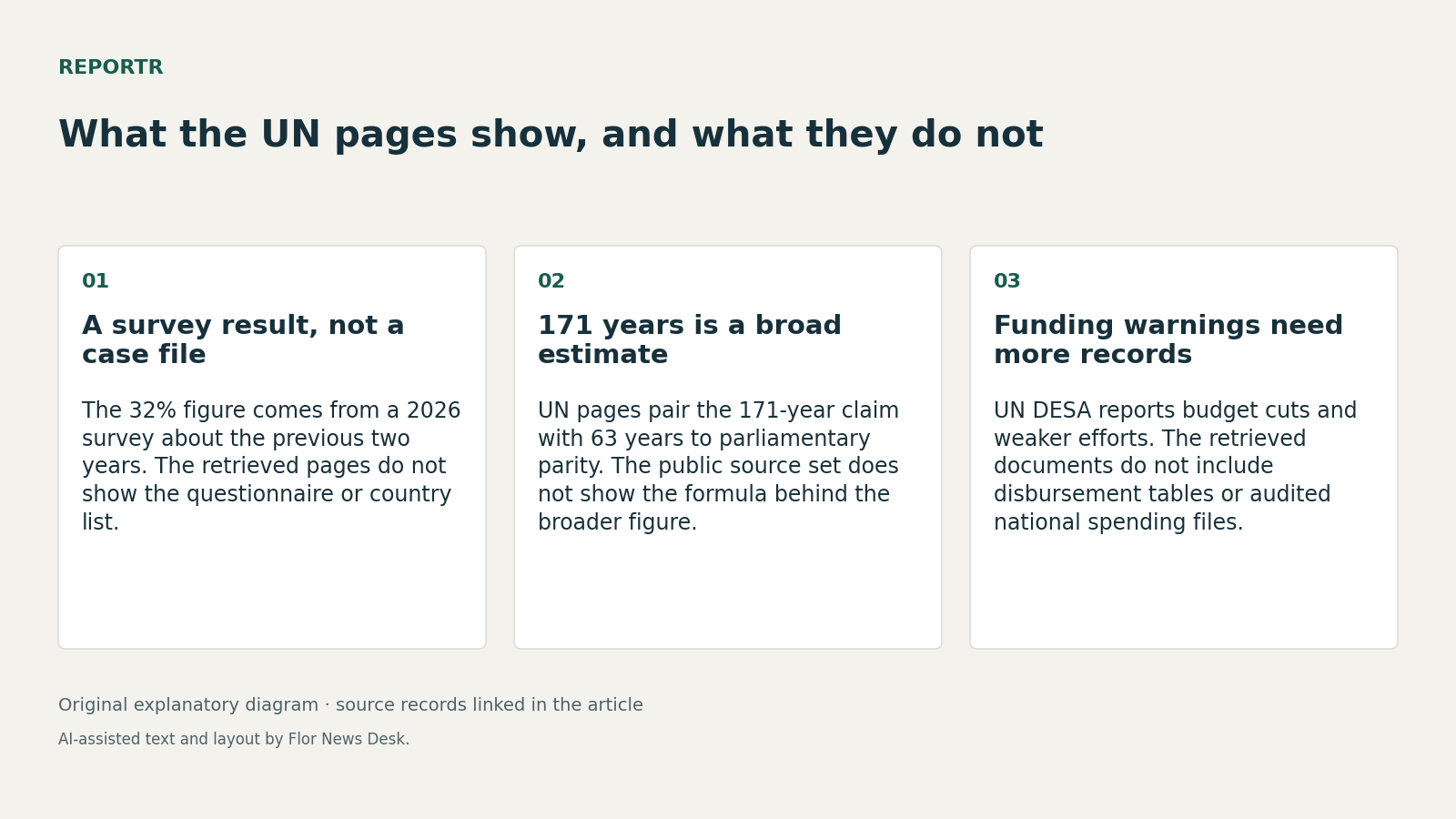
The UN’s 17 September 2026 Gender Snapshot release makes two headline claims that should not be treated as the same kind of evidence: 32 percent of national gender-equality mechanisms reported erosion of institutional power over the previous two years, and at current rates gender equality is still 171 years away UN DESA release Gender Snapshot 2026 page. The first is presented as a survey result with a defined lookback period. The second is a long-range pace estimate. In the source set retrieved for this draft, the public pages do not show the questionnaire, country breakdown or formula needed to test either claim in detail.
What the record does establish is narrower but still important. The Gender Snapshot page says a 2026 survey of national gender equality mechanisms found that 32 percent reported erosion of institutional power over the previous two years Gender Snapshot 2026 page. The 17 September UN DESA release adds two more institutional measures for that same period: about one in four of those mechanisms reported operating-budget cuts, and nearly one in ten lost control of their budget UN DESA release. That is evidence of reported retrenchment inside official gender-equality bodies. It is not, from these pages alone, proof of what legal powers changed in each country or what service outcomes followed.
The 171-year number is even broader. UN DESA says no indicator under Sustainable Development Goal 5 is on track for 2030 and that, at current rates, gender equality remains 171 years away UN DESA release. But the statistical landing page also breaks out a much shorter sector-specific projection: parity in national parliaments is 63 years away at the current pace Gender Snapshot 2026 page. That contrast matters. It shows the 171-year headline is not the timetable for every dimension of equality; it is a wider pace statement drawn from a larger set of measures. As of 8 October 2026, the retrieved pages do not show how that umbrella estimate is calculated or which indicators drive it most.
The same distinction applies to representation data. The Snapshot page gives a direct count for top courts: among 175 chief justices globally, 144 are men and 31 are women Gender Snapshot 2026 page. An 8 October 2026 commentary by Bjørg Sandkjær, Assistant Secretary-General for Policy Coordination at UN DESA, repeats the 171-year warning and adds that six in seven countries are led by men and more than eight in ten finance ministers are men Sandkjær commentary. Those figures help show how UN officials are framing the report politically, but that commentary is not a methods note and does not resolve how the composite projection was built.
Funding claims are also significant but only partly evidenced in this source set. The UN DESA release says funding for gender equality fell to its lowest level since 2021, that women’s rights organizations were the most affected, and that 42 percent of UN entities reported weaker gender-equality efforts amid funding cuts UN DESA release. Without disbursement tables, audit records or country files in the retrieved documents, those points should be read as institutional findings reported by the UN, not as independently testable global spending totals.
The useful reading of Gender Snapshot 2026, then, is as a warning flag with uneven levels of proof. The available UN record supports a claim that official gender-equality bodies reported lost power and budget pressure over a recent two-year period, and that representation gaps remain large across legislatures, courts and executive finance posts Gender Snapshot 2026 page UN DESA release Sandkjær commentary. It does not, from these pages alone, establish the country-by-country mechanics of institutional erosion or the technical basis for the 171-year projection.