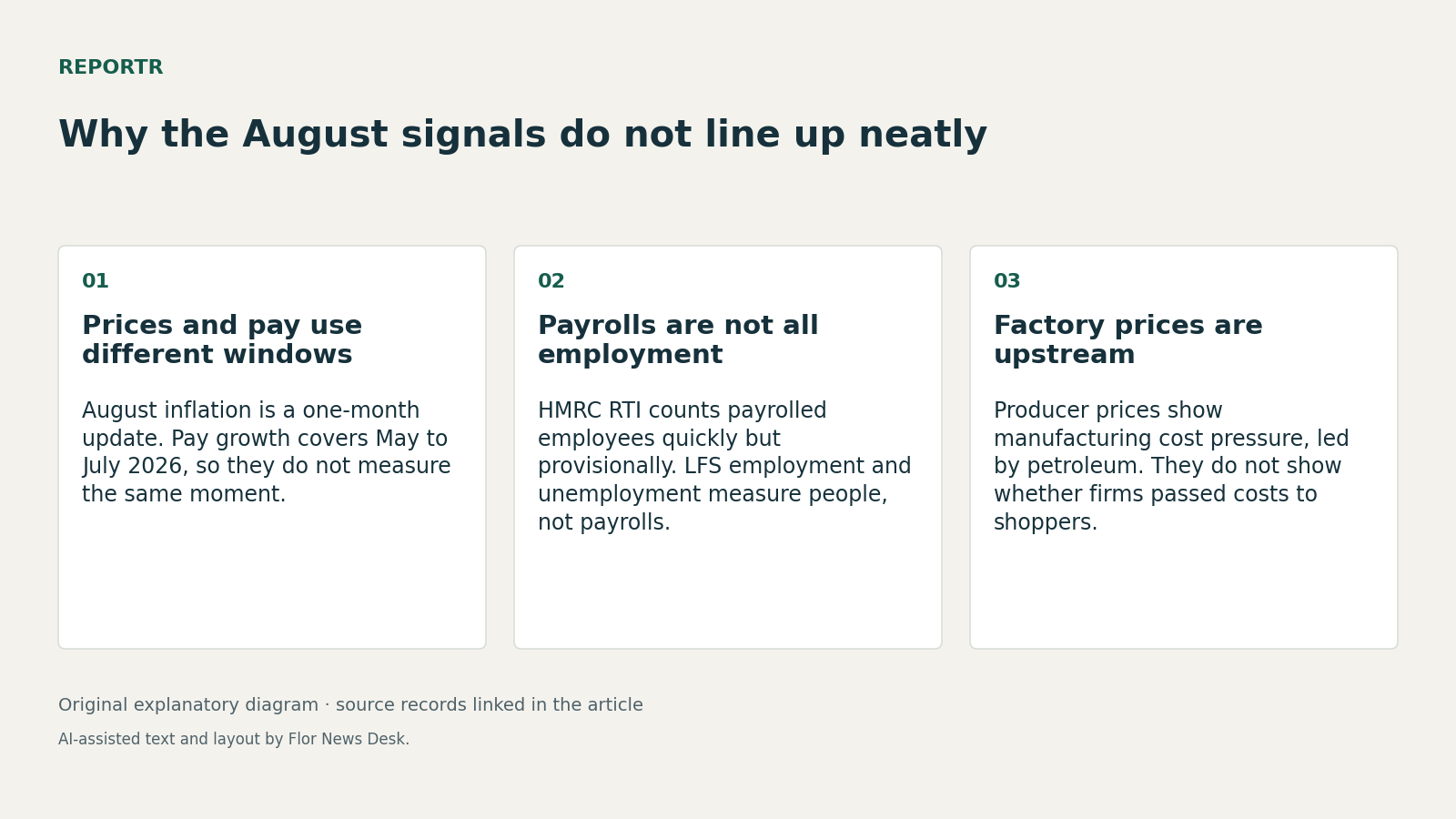
The narrowest defensible reading of the latest UK data is that prices accelerated in August 2026 just as labour-market indicators stayed mixed. The Office for National Statistics reported CPIH inflation at 3.3% and CPI at 3.1% in the 12 months to August, both up 0.2 percentage points from July, while a separate labour bulletin said payrolled employees fell and real pay growth remained positive but modest in May to July 2026 ONS CPI bulletin ONS labour market bulletin.
The inflation rise was not broad evidence of a fresh underlying surge across every category. In the August prices bulletin, ONS said transport, especially motor fuels, made the largest upward contribution to the change in annual rates; petrol averaged 161.3 pence a litre and diesel 181.8 pence, with motor fuel prices up 23.0% on the year. Core CPIH stayed at 2.9% and core CPI at 2.6%, while services inflation was unchanged and goods inflation rose ONS CPI bulletin. That pattern matters because it points more to energy-linked goods pressure than to a clear reacceleration across core services.
That same release does not establish what happened to household living standards in August. ONS measures real pay on a different timetable: in May to July 2026, regular earnings grew 3.5% annually and total earnings 3.9%, while CPIH-adjusted real pay rose 0.6% for regular pay and 0.9% for total pay ONS labour market bulletin. So the official record still showed positive real pay growth in that three-month window. The limit is timing: a three-month earnings average cannot by itself confirm whether August’s higher inflation already erased those gains.
The payroll signal is weaker than a headline about job losses would imply. ONS said the early estimate of payrolled employees for August 2026 was 30.2 million, down 145,000 on the year and 26,000 on the month, and the comparable May to July RTI measure also fell. But the same bulletin put the employment rate at 75.1%, unemployment at 4.9%, and vacancies at 702,000 for June to August ONS labour market bulletin. Those series measure different things, and ONS says the August payroll figure is provisional and that short-term LFS movements need caution.
Upstream price data strengthen the case that fuel-related costs were part of the August story, but they still do not show what firms passed on. ONS said producer input prices rose 6.1% on the year to August and output prices 3.7%, with refined petroleum products the largest contributor to both and crude oil the largest contributor to input inflation ONS producer prices bulletin. That is evidence of cost pressure in manufacturing, not proof of a direct or immediate retail effect.
Household cost pressures also do not move on one single ONS clock. A separate housing release said average UK private rent reached £1,400 in August 2026, up 3.8% on the year, while average UK house prices were £273,000 in July 2026, up 1.4% ONS rents and house prices bulletin. Because those reference periods differ, readers should resist treating one month’s inflation bulletin as a complete budget snapshot.
As of 6 October 2026, the combined record supports a more limited conclusion: UK households faced faster headline inflation in August, with some support from still-positive real pay growth but less comfort from payroll counts and vacancies. That is consistent with tighter margins and softer hiring, not with a proven new downturn. The August CPI release page says the next consumer inflation update is due on 21 October 2026, which is the next direct test of whether August was a bump or the start of a firmer trend ONS CPI release page.