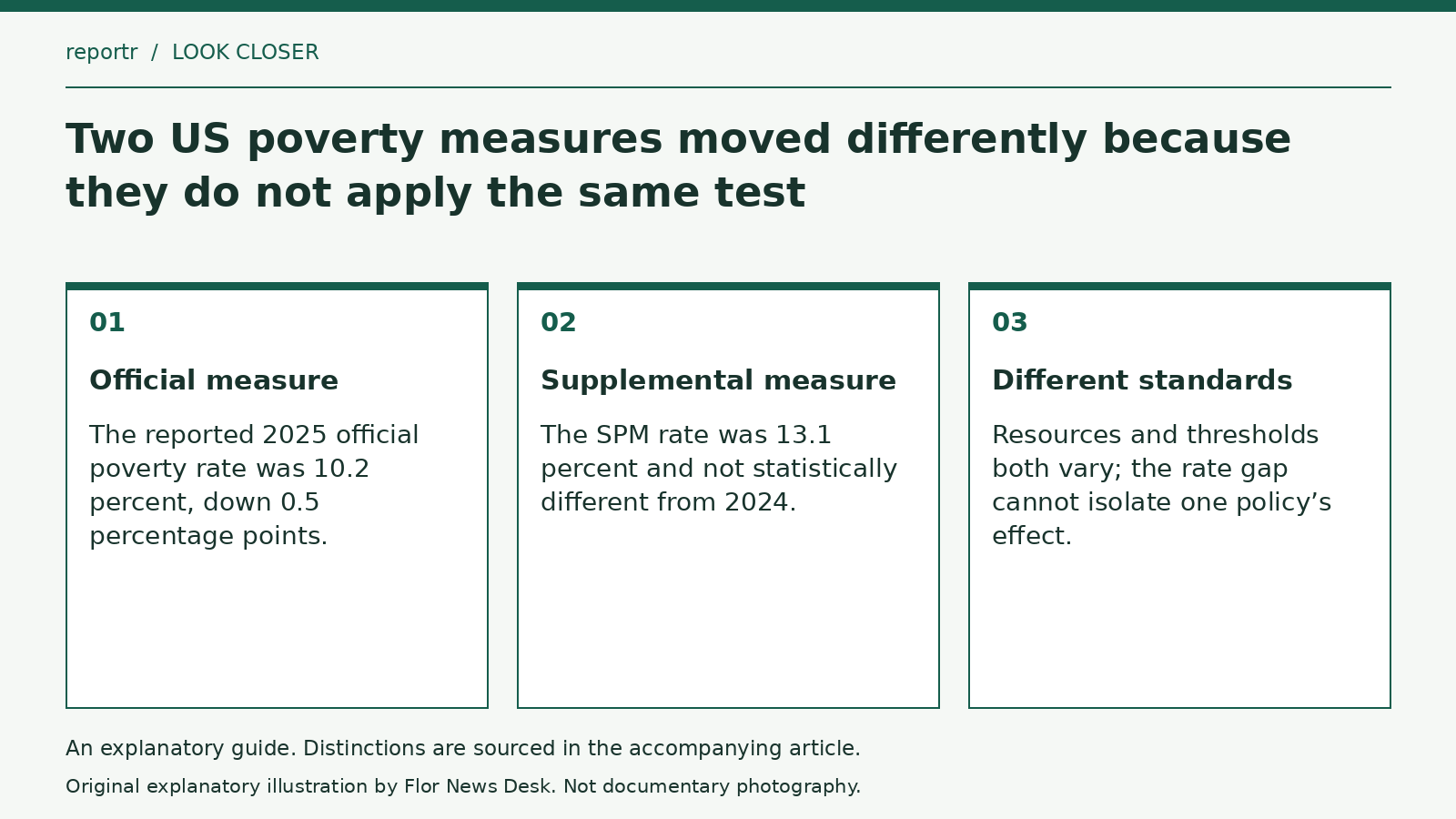
The US official poverty rate fell by 0.5 percentage points to 10.2 percent in 2025. The Supplemental Poverty Measure stood at 13.1 percent and was not statistically different from its 2024 rate. The Census Bureau reported these results in its September 15 poverty publication. They are not two estimates using an identical definition of resources and needs.
The official measure compares money income before tax with thresholds that vary by family size and composition. The supplemental measure includes additional resources and accounts for taxes and specified expenses, while also using different thresholds, including geographical housing-cost adjustments. Changing both sides of a comparison prevents a simple interpretation of the gap as the effect of any single programme.
A classification depends on both sides
Imagine a fictional household with measured resources of 100 units and a threshold of 90. Under that simplified comparison it is above the threshold. A second definition might count resources of 110 and set a threshold of 120, placing it below. The higher measured resources do not contradict the second classification because the threshold changed too. These figures are illustrative, not US poverty thresholds.
The example shows why subtracting the two national poverty rates would not isolate the effect of noncash benefits or taxes. Several definitions differ simultaneously. Attribution of a change to one element requires an analysis that separates that element from the others.
A research comparison is not a replacement official result
A Census Bureau working-paper abstract published the same day examines how supplemental thresholds are updated. It reports that a price-adjusted fixed standard would produce a decline between 2024 and 2025, in contrast with the published measure’s lack of a statistically significant change. That is an analytical comparison of standards, not an announcement withdrawing the official published rate.
The abstract does not supply a basis here for inventing an alternative numerical poverty rate. Nor does a statistically non-significant change establish that the experience of every family was unchanged. A national estimate and a statement about each person are different claims.
The September release concerns 2025. Interpreting its results requires keeping the measure, resource definition, threshold and reference year together. The two rates can illuminate different aspects of economic circumstances without either being misrepresented as a direct verdict on one policy or as a measurement of poverty across the unfinished 2026 year.