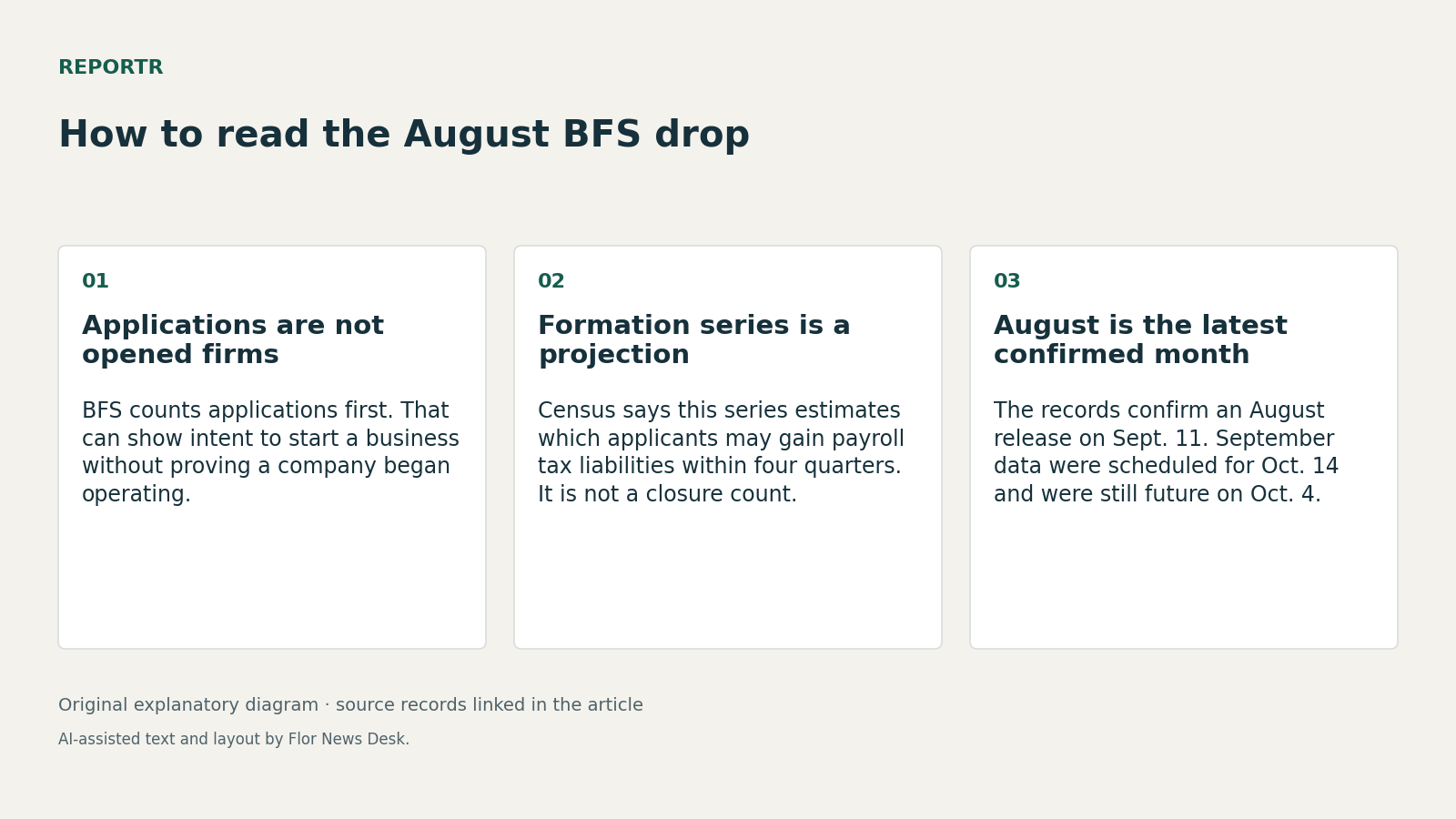
On September 11, 2026, the U.S. Census Bureau’s August Business Formation Statistics page reported 531,728 seasonally adjusted business applications. The same page said its projection for businesses expected to develop payroll tax liabilities within four quarters was 4.6% below the analogous July projection. That is evidence that August produced fewer expected employer-business formations than July within this dataset, not proof that operating businesses disappeared. BFS August release
What the Business Formation Statistics, or BFS, measure is narrower than a broad claim about entrepreneurship. Census describes BFS as a monthly, high-frequency product on new business applications and formations in the United States and Puerto Rico. It says the full monthly release contains 12 series, with both seasonally adjusted and not seasonally adjusted data, and that statistics are published for the nation, regions and states. Census newsroom note That makes BFS useful for tracking changes quickly, but it also means one national headline number is only part of the record.
The most important distinction is between an application and a formation. On the program page, Census says the projected formation series refers to startups with payroll tax liabilities expected to form within four quarters of application. BFS August release In plain terms, the series is forward-looking. A lower August projection changes the agency’s expectation about which applicants may become employer businesses over the next year. It is not a direct count of firms that opened in August, and it does not measure closures or startup failures.
The source record also shows why month-to-month readings need careful handling. Census says Puerto Rico’s monthly business-application series are now part of the standard monthly product rather than a separate experimental product, and the August page includes formal disclosure-review identifiers. BFS August release The newsroom note separately says the product includes both adjusted and unadjusted series. Census newsroom note None of that establishes the cause of August’s movement. It does show that readers should verify which series they are comparing before treating one monthly shift as a change in the underlying economy.
Timing matters too. As of October 4, 2026, August is the latest BFS month confirmed by the records supplied here. Census’s release schedule lists the August 2026 publication on September 11, 2026, and shows the September 2026 data were scheduled for October 14, 2026, which was still in the future on October 4. BFS release schedule So these documents cannot establish whether August was the start of a broader slowdown, a one-month interruption, or ordinary volatility. The supplied excerpt from Census’s general latest-releases index does not show a BFS listing, which is another reason to rely on the BFS-specific pages for timing and contents. Latest Data Releases index
The strongest evidence-led conclusion is therefore limited. Census has published a lower August forward-looking signal inside BFS, but the working record here does not preserve the July application benchmark, the longer time series or the yet-unreleased September figures. BFS August release, BFS release schedule Before making broader claims about the U.S. startup climate, the next check is inside the same product: compare the national August figures with the regional and state BFS series that Census says it publishes, and then see whether the scheduled October 14 release confirms or interrupts the August move. Census newsroom note