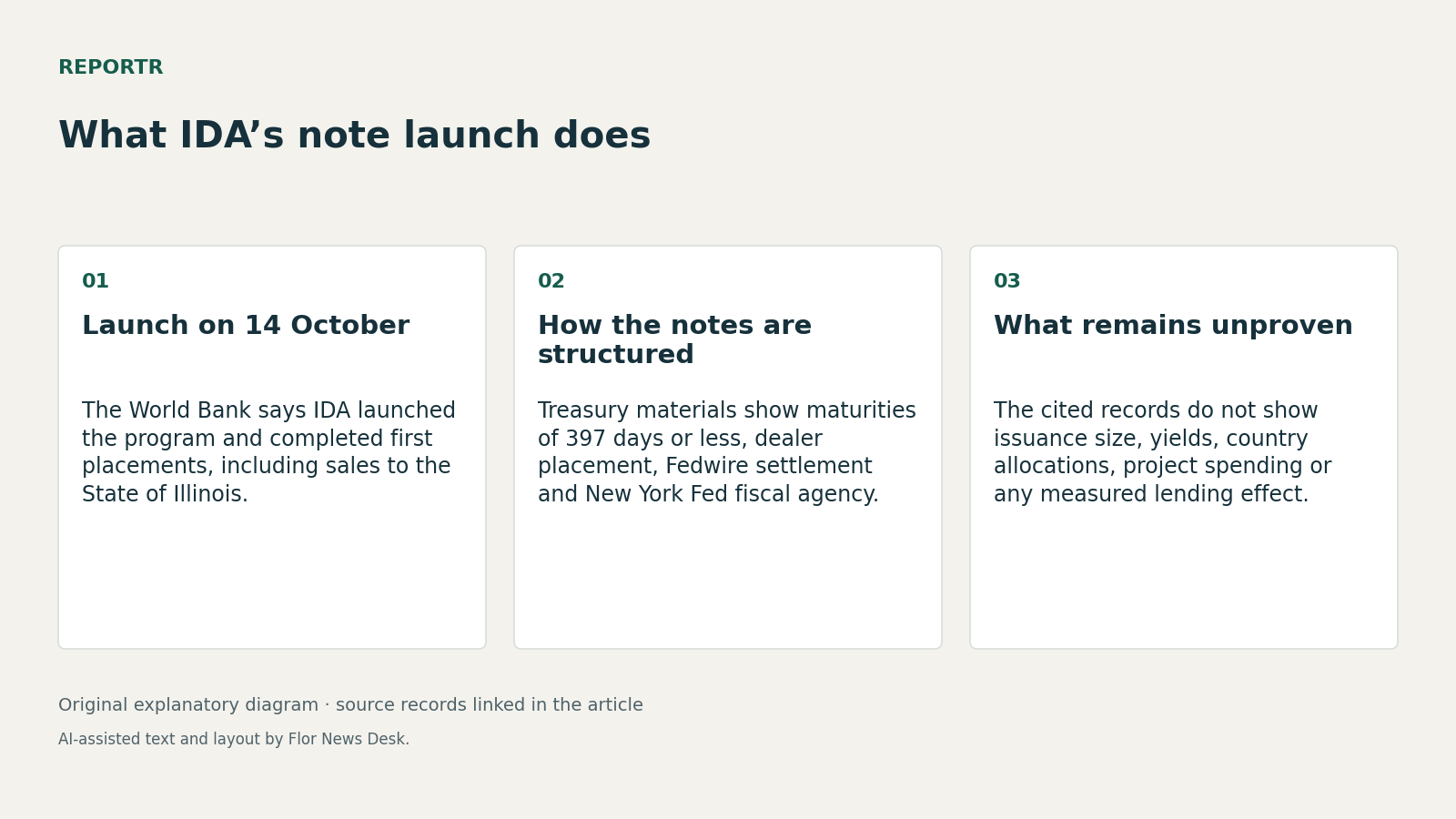
On 14 October 2026, the World Bank said the International Development Association had launched an IDA Discount Notes Program and completed its first issuances. The clearest change in the record is institutional, not developmental: IDA now has a documented short-term funding channel in U.S. and Eurodollar markets, with notes of 397 days or less offered through a dealer group, according to the World Bank press release and Treasury product page (press release, Treasury page).
The launch-day evidence is specific about initial participation but thin on transaction detail. The World Bank said the first series was bought by the State of Illinois and other U.S. public-sector investors, along with state and municipal treasuries and corporate funds. The same release said the notes are exempted securities under U.S. federal securities laws, are issued and settled through Fedwire, and use the Federal Reserve Bank of New York as fiscal agent (press release). That shows the program entered established U.S. money-market plumbing. It does not, by itself, show how large the first placements were or what price investors accepted.
The Treasury page fills in the product design. It describes IDA Discount Notes as short-term investments in U.S. and Eurodollar markets, says maturities run to 397 days or less, and lists an aggregate face amount of US$50,000 and higher per maturity date, with US$1,000 denominations and integral multiples. It also says rates are posted on Bloomberg page IDADN (Treasury page). A separate World Bank debt-products FAQ, while about International Bank for Reconstruction and Development debt products rather than direct proof of IDA issuance, helps explain the format: discount notes are offered on a continuous basis and can vary by settlement date, amount and maturity (FAQ). Read together, those records point to an ongoing short-term instrument rather than a one-off benchmark bond sale.
That distinction matters because a new funding tool is not the same thing as new lending. The available records do not state the size, tenor, yield or total volume of notes sold by 16 October 2026, nor do they establish whether the program has lowered IDA’s borrowing costs. Any claim that the launch has already expanded lending capacity would go beyond the cited documents (press release, Treasury page). The evidence supports a narrower conclusion: IDA has added a short-dated market-access option and recorded first placements.
The World Bank’s own disclaimer is also important for development-finance readers. The press release says net proceeds are not committed or earmarked for any particular projects or programs, and that payments on the securities are not funded by any project or program (press release). That blocks a common but unsupported leap from fundraising news to country-level impact. No cited document links these notes to specific borrowing countries, project approvals, or disbursement schedules.
So the substantive news is narrower than a headline about development funding might suggest. IDA now has a public short-term note program with first named buyers and U.S. settlement arrangements. What remains unproven in the source record is just as important: there is no public issuance total, no pricing evidence, no country allocation, and no measured effect on IDA lending yet (press release, Treasury page, FAQ).