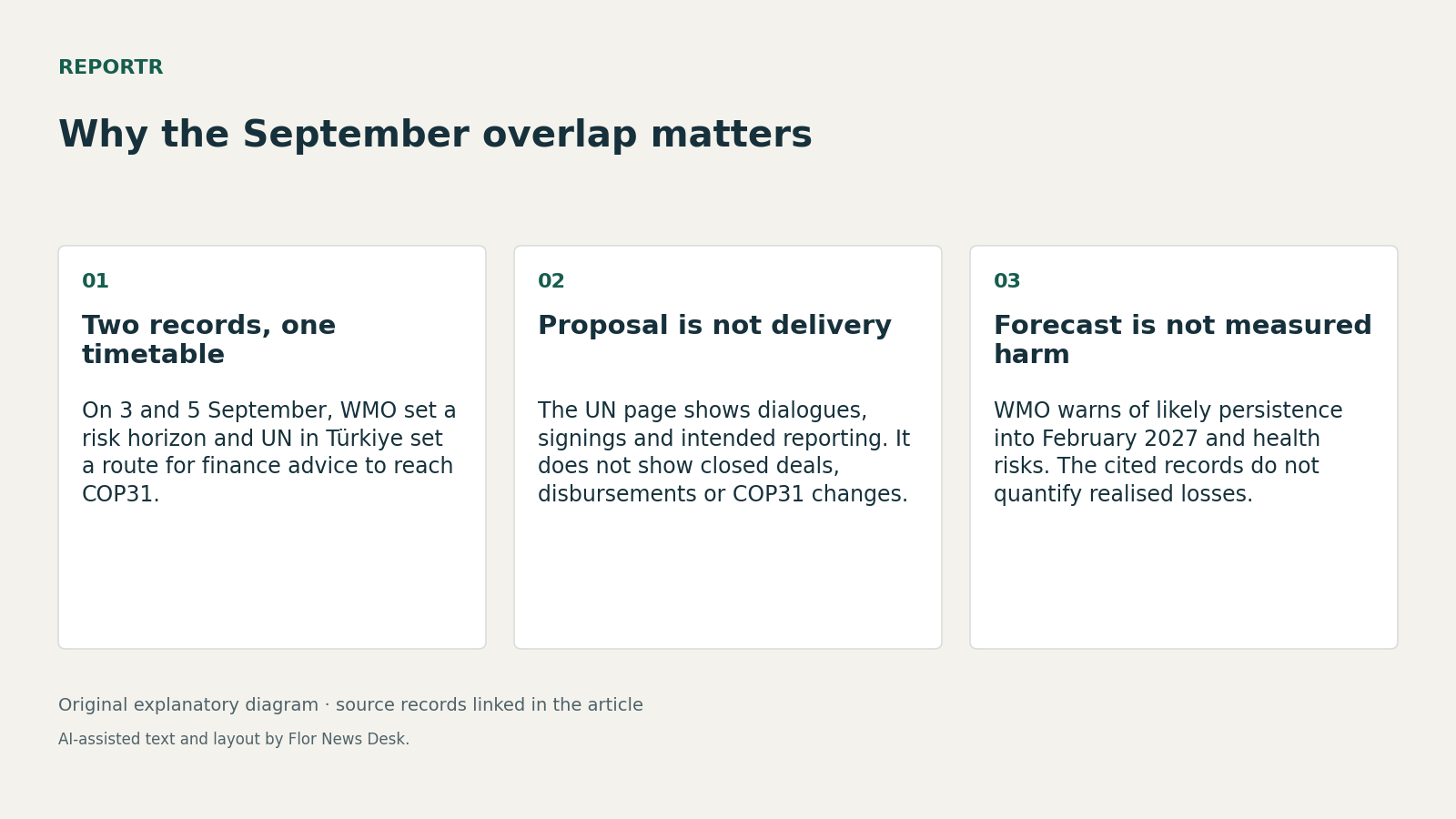
The clearest September 2026 development is not a new climate-finance deal. It is a timing overlap. On 5 September 2026, the United Nations in Türkiye said recommendations from a climate-finance policy dialogue in Istanbul would be sent to the COP31 Presidency and the Office of the Climate High-Level Champion (United Nations in Türkiye, 5 September 2026). Two days earlier, the World Meteorological Organization said forecasting centres saw an almost certain chance that El Niño would continue through February 2027 and strengthen further before the end of 2026 (WMO, 3 September 2026).
That pairing matters because one record describes a policy pathway and the other defines a near-term hazard window. The WMO forecast reaches beyond COP31 rather than ending before it, so the conference is framed not only by long-run decarbonisation debates but also by a live risk outlook for early 2027 (WMO, 3 September 2026). A separate WMO update on 11 September 2026 adds context: it said August 2026 was the hottest August on record and that WMO would present a climate update at COP31 in Antalya, Turkey, in November (WMO, 11 September 2026). That does not prove any negotiating outcome, but it shows climate-risk evidence and finance-policy proposals moving toward the same forum.
The Istanbul record is important partly for what it does not establish. The United Nations in Türkiye said the dialogue was convened by the Ministry of Treasury and Finance, the United Nations in Türkiye and the Office of the COP31 Climate High-Level Champion, and that it included protocol signings involving the World Bank, the Development and Investment Bank of Türkiye (TKYB) and the Industrial Development Bank of Türkiye (TSKB) (United Nations in Türkiye, 5 September 2026). It also records a Declaration of Intent between the Ministry of Treasury and Finance and the United Nations in Türkiye. But the retrieved page does not include the promised recommendations report, any transaction values, disbursements, or evidence that COP31 documents were changed. As of 27 September 2026, the document supports a channel for proposals, not proof that money has moved.
The WMO material has a similar limit on the risk side. The 3 September item is a forecast record, supported by ocean-temperature indicators, not an audit of damages or losses already incurred (WMO, 3 September 2026). On 23 September 2026, WMO pushed the issue into public-health planning, saying countries and communities should prepare for health risks linked to the strengthening event and pointing to a World Health Organization situation analysis covering threats such as extreme heat, smoke, water security, nutrition and vector-borne disease (WMO, 23 September 2026). That expands the case for preparedness, but it still does not measure realised health impacts or identify funded responses.
So the September calendar matters less as evidence of delivery than as evidence of compression. The finance side says recommendations are supposed to reach COP31. The climate side says the hazard outlook is already unusually strong and likely to persist into early 2027. Put together, the records increase pressure on negotiators, development banks and governments to show whether proposed finance mechanisms can move from dialogue to named commitments before or during COP31.
The next proof points are therefore straightforward. If the concise report appears, readers can test what recommendations were actually sent. If COP31 materials reflect those ideas, the link becomes concrete. If institutions announce commitments, closings or disbursements, the story shifts from agenda-setting to implementation. Until then, the strongest evidenced conclusion is narrower: in September 2026, official records placed climate-finance recommendations and elevated El Niño risk on the same immediate path toward COP31, without yet showing that finance has matched the risk.