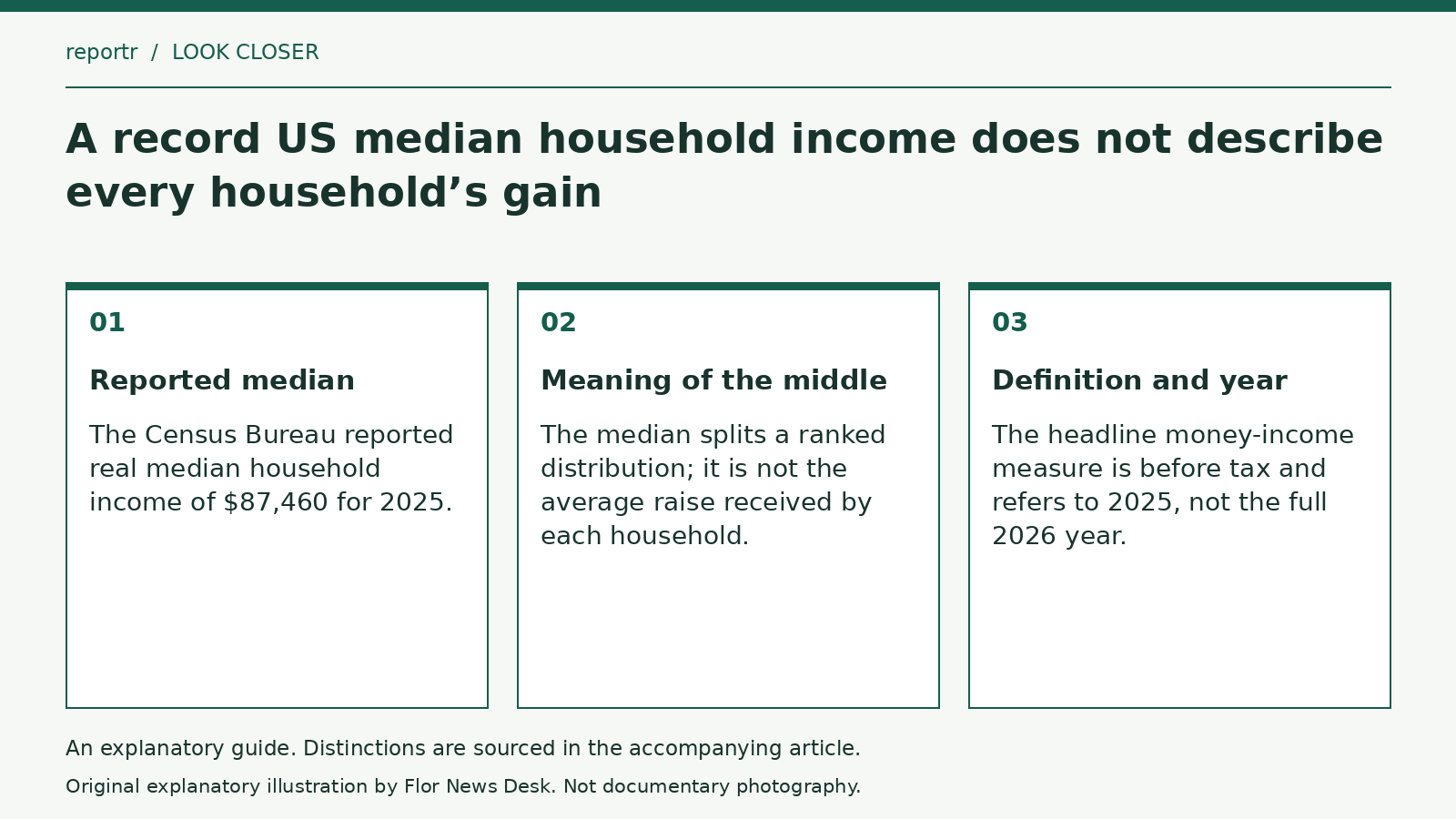
Real median US household income reached $87,460 in 2025, up 2.6 percent from $85,210 in 2024, according to the Census Bureau’s September 15 account. The bureau described the level as the highest in the series beginning in 1967. That is an inflation-adjusted statistical comparison, not a statement that every household received a 2.6 percent raise.
The median is the point dividing a ranked distribution into two halves. It is different from the arithmetic mean and from a record following the same household through time. Reporting the new median alone does not show which particular families gained or lost income.
The middle can hide different distributions
Consider five fictional household incomes of 20, 30, 40, 50 and 60 units. The median is 40. Replacing the highest value with 600 leaves the median at 40 while changing the mean substantially. These invented values illustrate why a middle value does not describe the upper end of a distribution.
Likewise, two annual distributions can have different medians without identifying the income change experienced by any one household. A claim about an individual household’s gain requires matched information about that household, rather than only the two annual middle values.
Know what counts as income
The accompanying Income in the United States report explains that its money-income measure is before tax and does not include noncash benefits. The report also presents post-tax measures. Those are different definitions, so a reader should not compare a pre-tax figure from one table with a post-tax figure from another as though their boundaries were identical.
The report says the Gini measure of income inequality did not change significantly between 2024 and 2025. This is a separate observation from the rise in the median. Growth in a middle value does not logically require either a widening or a narrowing of the whole distribution.
The reference year is 2025, even though the results were published in September 2026. The report uses the 2026 Current Population Survey Annual Social and Economic Supplement to describe that earlier year. It is not a measurement of household income earned across all of 2026.
The record median is therefore best reported with its year, inflation adjustment and income definition intact. It identifies an important change in the distribution’s middle, while leaving household-specific experience and other aspects of the distribution to their own evidence.