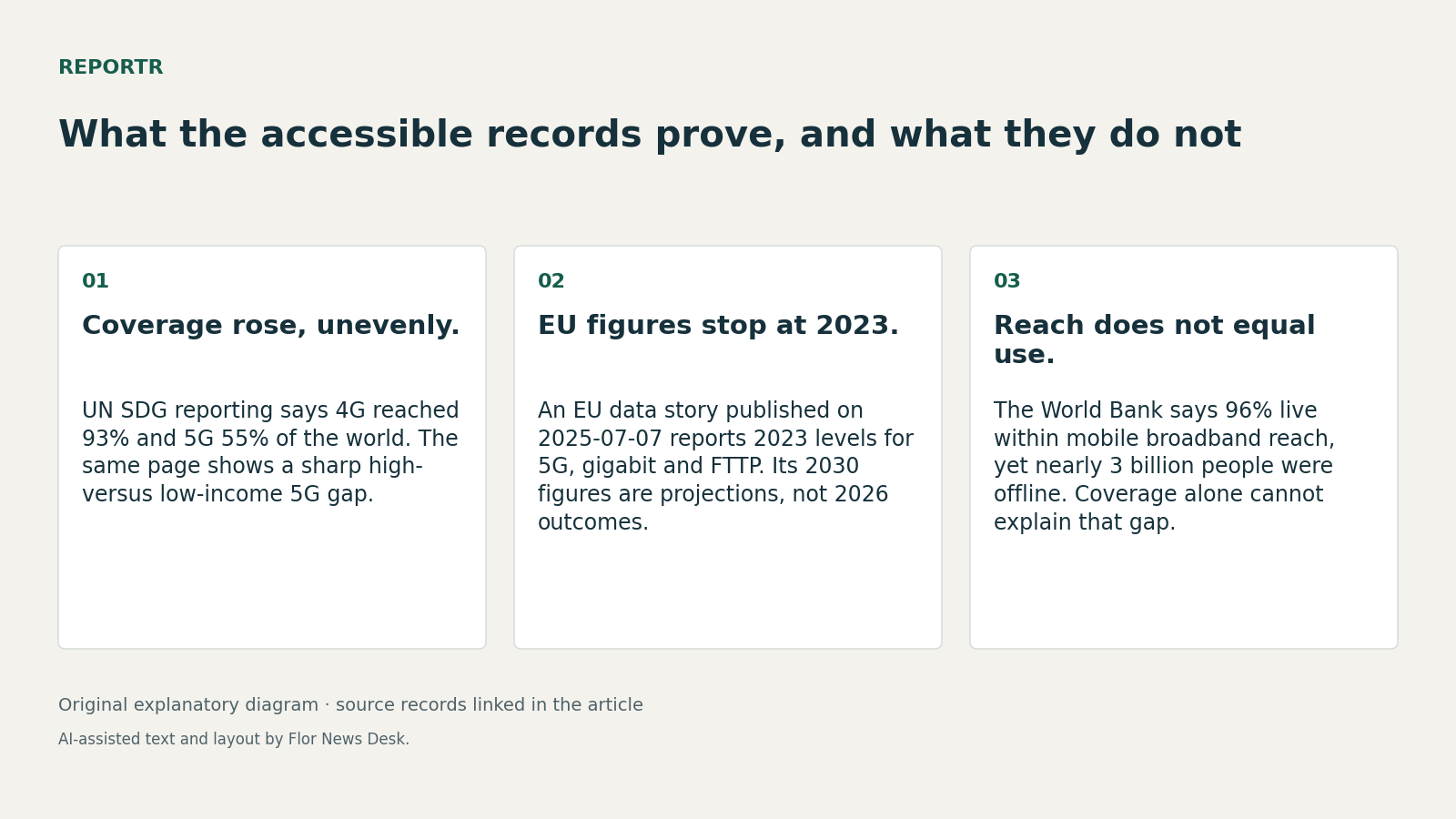
The accessible record supports a narrower finding than many connectivity announcements imply: network reach has expanded, but the same sources do not show whether people and businesses can actually get affordable, reliable high-capacity service. The clearest evidence comes from an undated UN SDG Goal 9 page, an EU data story published on 2025-07-07, and a World Bank data story published on 2026-05-05, each measuring a different part of the problem rather than a full end-to-end outcome (UN SDG Goal 9; EU Digital Decade data story; World Bank data story).
The UN page shows why simple global averages can mislead. It says 4G reached 93% of the world’s population, 3G 96%, and 5G 55% (UN SDG Goal 9). But the same page also says 5G coverage was 84% in high-income countries and 4% in low-income countries, while 12% of people in least developed countries and 11% in landlocked developing countries still lacked any mobile broadband signal (UN SDG Goal 9). That means the headline expansion is real, yet the remaining divide is still strongly geographic and income-linked.
Even those UN figures need careful handling on date. The retrieved page contains a timing inconsistency: one passage ties the 55% 5G figure to 2026, another to 2025 (UN SDG Goal 9). As of 2026-10-21, that page therefore supports the existence of a recent global 5G expansion, but not a precise one-year status line that can be stated without qualification.
The EU record is more specific on fixed and mobile infrastructure, and more limited in time. The European data story says 5G covered 89.3% of populated areas in EU member states in 2023, gigabit connectivity reached 78.8% of households in 2023, and FTTP coverage rose from 56.4% in 2022 to 64.0% in 2023 (EU Digital Decade data story). It also shows 2030 projections of 94.7% for gigabit connectivity and 89.5% for FTTP (EU Digital Decade data story). Those projections matter politically, but they are not measured 2026 outcomes. Any claim that Europe is already on track after 2023 would need newer evidence than this page provides.
The World Bank record shows why coverage alone cannot answer the harder question of digital use. Its 2026 data story says, citing ITU 2024, that 96% of the world’s population lives within reach of mobile broadband networks, yet nearly 3 billion people, or 38% of the global population, remain offline (World Bank data story). It also says Global Findex Digital Connectivity Tracker 2025 data show about 1.4 billion adults do not use the internet across 81 of 123 low- and middle-income countries, including 800 million women (World Bank data story).
Taken together, those records support an important analytical distinction. A signal map can show where service is technically available; it cannot by itself show whether households can afford access, whether speeds hold up at the last mile, whether outages are manageable, or whether fibre backhaul and electricity are sufficient for more demanding services. That is not a criticism of the institutions’ numbers. It is a statement about scope: the UN page measures coverage, the EU page adds infrastructure indicators and projections, and the World Bank page shows that non-use persists even where coverage exists.
So the evidence-based conclusion is not that connectivity goals are failing, or that they are complete. It is that expansion and readiness are different claims. The accessible sources document expansion. They do not establish post-2023 EU delivery, global retail affordability, measured performance, resilience, or whether these networks are already adequate for broader cloud and AI-related demand. Readers should treat any stronger claim as unproven unless it is backed by newer regulator, operator or independent performance records.