The European data portal described its Metadata Quality Assessment tool in an October 2025 introduction. The tool examines metadata harvested from connected portals, including elements related to standards, machine readability and reuse. That subject is the information describing a dataset, not an independent investigation of every observation contained inside it.
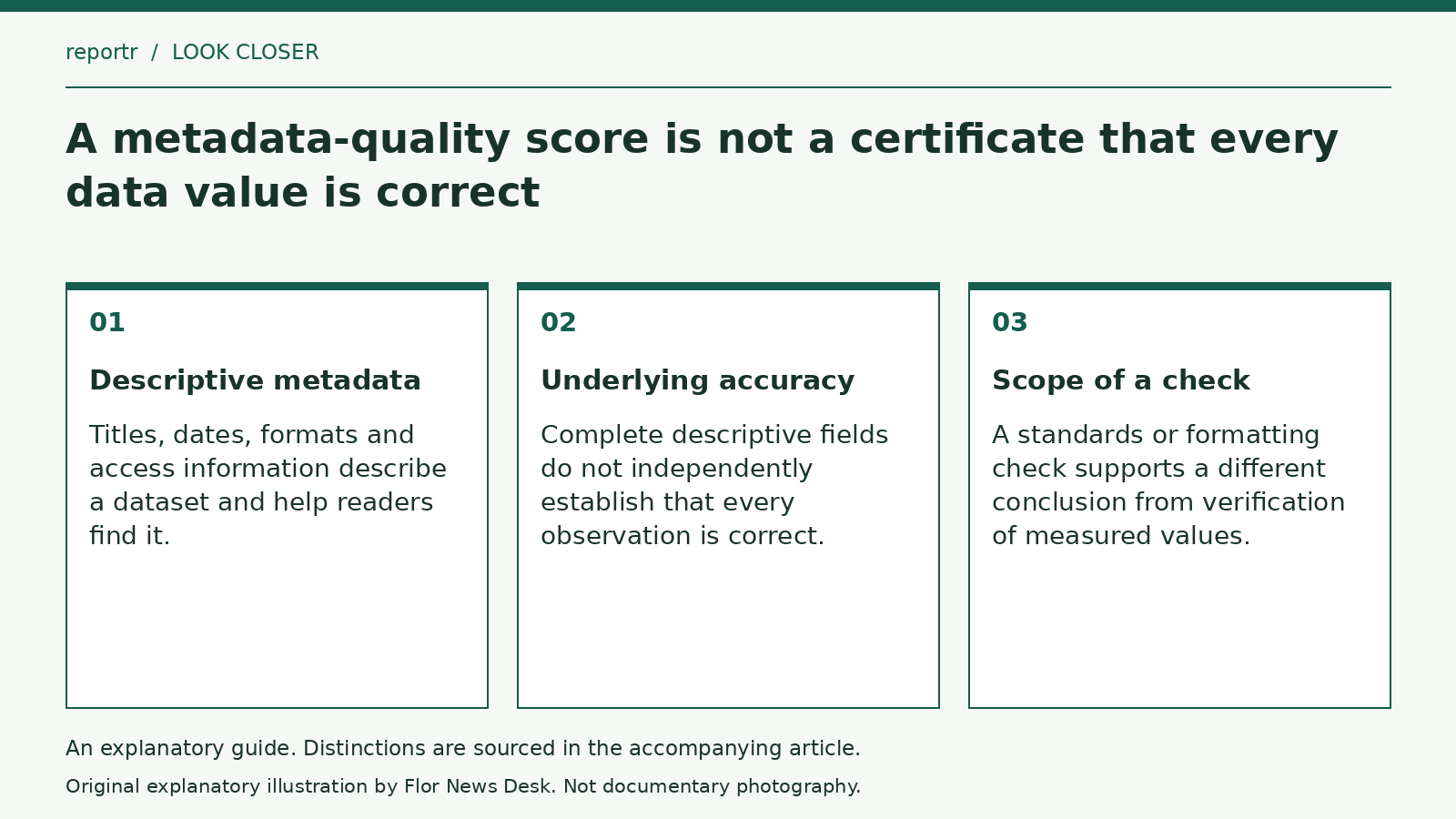
A useful catalogue description helps a reader discover a resource and understand its intended contents. It does not, simply by being complete, establish that every number in the resource was measured correctly. Confusing these two claims gives a metadata score a broader meaning than the described assessment supports.
A valid description can accompany a wrong value
Imagine a fictional temperature dataset with a clear title, units, date range, licence field and working download link. One sensor value could still have been entered incorrectly. The presence of the descriptive fields would not identify that particular error unless a separate check examined the observation.
The reverse is also possible as an analytical example: a carefully measured dataset could be difficult to discover or interpret because its catalogue description was incomplete. Improving that description would improve access to the evidence without changing the underlying measurements. Neither example is a finding about a dataset on the European portal.
Statistics Canada’s Data Quality Toolkit distinguishes accuracy from conformance to standards. Accuracy concerns how correctly data describe the phenomenon being measured; conformance concerns recognized formats and conventions. The distinction provides a useful way to ask what a reported quality check actually tested.
The test and its conclusion must match
In the fictional sensor file, verifying that a date follows an accepted format would answer a formatting question. Confirming that the date records when the observation occurred would require other evidence. A syntactically valid entry is not necessarily a historically correct one.
Similarly, a recorded licence field and a determination of every legal condition for reuse are different propositions. This article makes no legal assessment of a particular dataset. It identifies the missing evidentiary step in treating the existence of a field as proof of all the claims a reader might associate with it.
The portal’s introduction is a dated description of a tool, not a new September 2026 scorecard. No current country ranking or dashboard score is reported here. The practical reading question is specific: was the check about discoverability, accessibility, format, description or the underlying observations? A quality result is most informative when its scope remains visible.