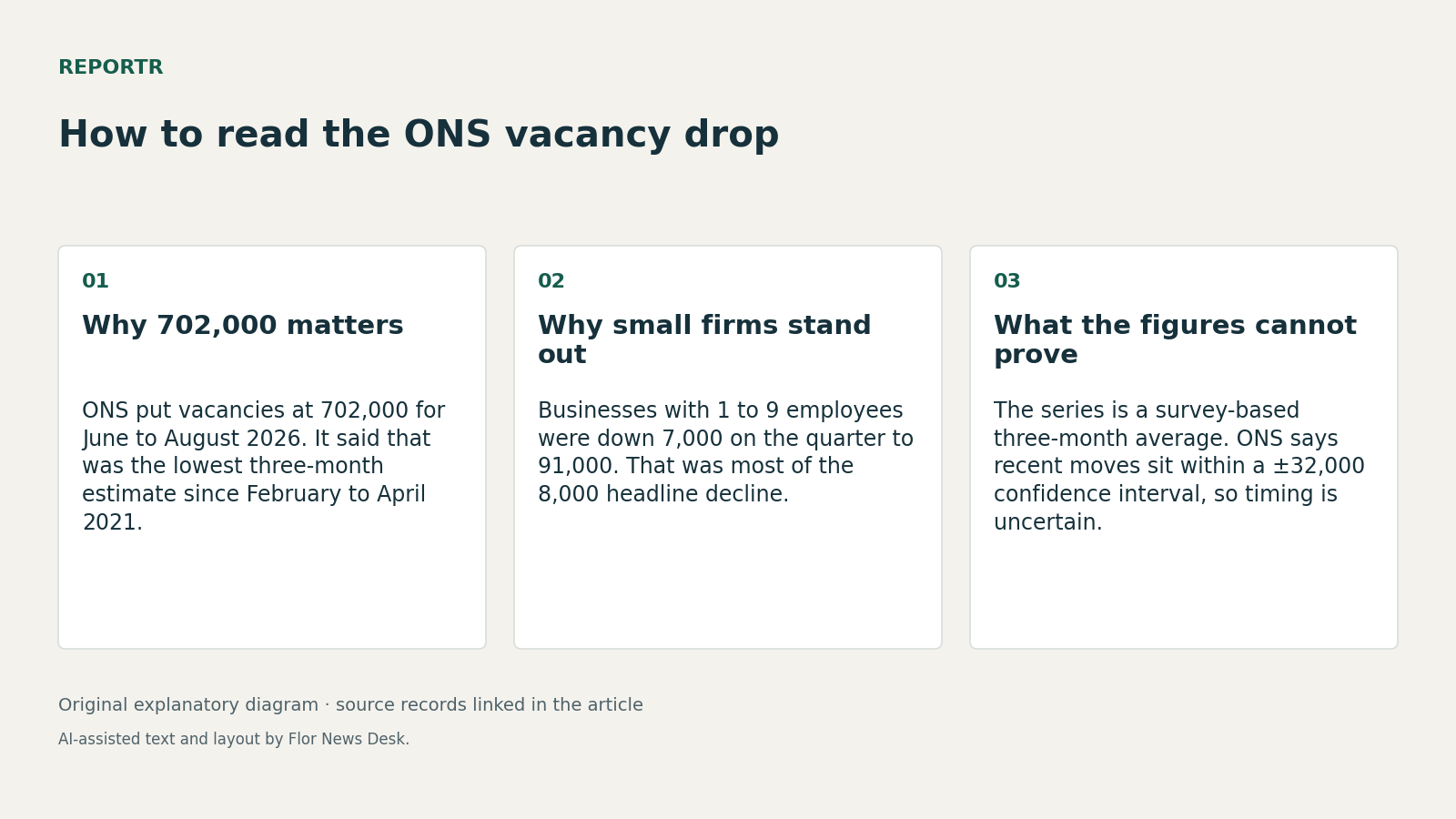
The UK’s vacancy count fell to 702,000 in June to August 2026, the lowest three-month estimate since February to April 2021, according to the Office for National Statistics bulletin published on 15 September 2026 as part of its monthly labour-market package (vacancies bulletin, release page). That does not, by itself, prove a sudden break in hiring in August. It does show that the stock of advertised jobs has moved down to a level not seen in the headline series for more than five years.
The same bulletin said the unemployment-to-vacancy ratio was 2.5 in May to July 2026 and had remained at 2.5 since July to September 2025 (vacancies bulletin). Read together, those two figures support a narrower conclusion than many labour-market headlines imply. The hiring market looks cooler than the exceptionally tight post-pandemic period, but the retrieved records do not show a fresh surge in slack in the latest reading. A multi-year low in vacancies and an unchanged ratio are evidence of easing, not of a sudden collapse.
The most striking composition point is the size breakdown. ONS said businesses with 1 to 9 employees recorded the largest quarterly fall, down 7,000 to 91,000, and the largest annual fall, down 28,000 (vacancies bulletin). Because the overall quarterly decline was 8,000, that one size band accounts for most of the arithmetic change in the headline total. That does not mean only the smallest employers cut hiring plans, but it does mean the latest softening was disproportionately concentrated there.
Sector data point in the same direction, though less dramatically. ONS said 10 of 18 industry sectors showed quarterly vacancy falls, with education posting the largest volume decline at 5,000 (vacancies bulletin). That matters because it argues against treating the headline move as a one-sector distortion. Still, 10 of 18 is not all 18. The source record supports a picture of weakening spread across more sectors than not, not a universal retreat.
The release also sets clear limits on how far the latest drop can be pushed. ONS describes the vacancies series as an early estimate from a sample survey and a three-month average rather than a single-month count. It says both the quarter-on-quarter change and the fall since January to March 2026 are within an approximate 95% confidence interval of plus or minus 32,000 vacancies (vacancies bulletin). In practical terms, that means the exact size of the recent decline is uncertain. The more robust signal is the lower level over time, not the precision of an 8,000 move.
The package structure is also worth noting. The ONS release hub links vacancies, unemployment and related datasets, including UNEM01 (release page). But the retrieved UNEM01 page is metadata for a not-seasonally-adjusted Labour Force Survey dataset and does not provide a September 2026 unemployment value or an independent unemployment-to-vacancy ratio calculation (UNEM01 metadata). So the ratio used here rests on the vacancies bulletin’s own statement. The bulletin also includes survey feedback about labour costs among smaller firms, but that feedback does not establish causation. The strongest evidenced conclusion from these records is narrower: by late summer 2026, UK employers were advertising fewer jobs, and the retreat was especially visible among the smallest businesses.